
Study 23: 2 Samuel 14: 1-24: Trent Evans
Three years after Absalom fled Jerusalem, David still longs for his son, yet he does nothing to restore the relationship. Joab sees the unresolved distance and sends a wise woman from Tekoa to tell David a carefully constructed story about a widow whose surviving son faces death after killing his brother. David readily extends mercy to the imaginary son, but the woman forces him to confront the contradiction in his own heart: he can recognize mercy when it costs him nothing, yet resist it when mercy touches his own wound. The question becomes deeply personal: Why is it sometimes easier to believe in grace for someone else than to practice it ourselves?
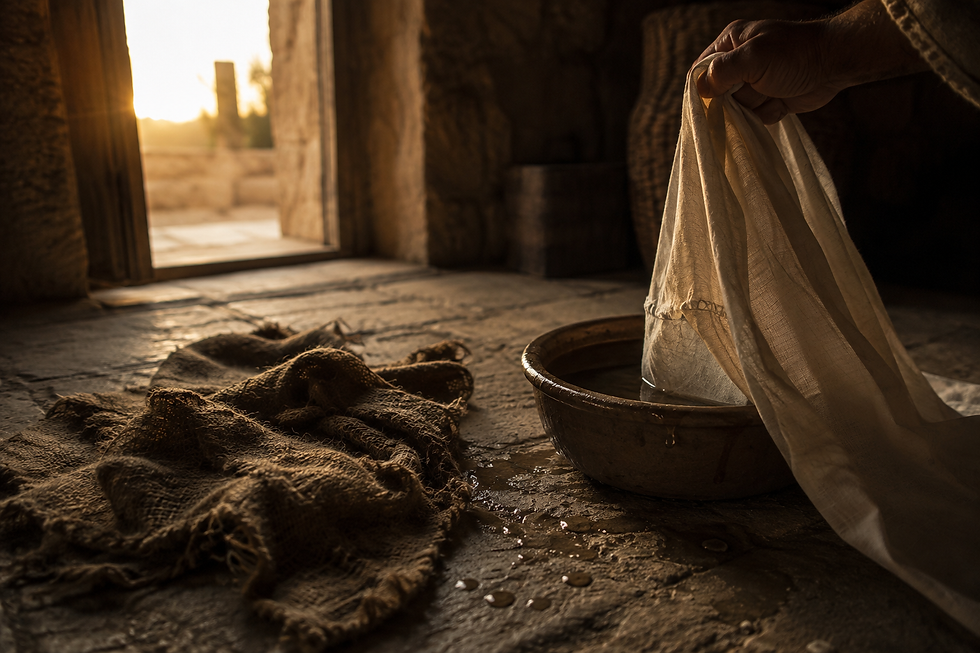
The woman's most striking declaration is that although human life disappears "like water spilled on the ground," God "devises ways" so that the banished are not permanently cast away. The sermon sees here a powerful contrast between David and God. David permits Absalom to return to Jerusalem but still refuses to see his face; the physical distance closes while the relational distance remains. But God is not a King who merely allows the banished to exist somewhere nearby. In Christ, God initiates, moves toward us, and closes the gap. The invitation of the gospel is therefore not merely to live near the things of God, but to surrender the heart and seek the face of the King. u

Sermon Outline
I. A Father Who Longs but Does Not Move
Main Teaching Point: Desire for reconciliation is not the same thing as pursuing reconciliation.
Key Scripture: 2 Samuel 13:37–39; 14:1
Absalom has lived in exile for three years after arranging Amnon's death. David longs for his son, but he does nothing. This continues a troubling pattern in David's family: after Tamar's rape, David became angry but failed to act justly toward Amnon. Absalom then took justice into his own hands, and the family fractured further.
The opening tension of chapter 14 is therefore not whether David cares. He cares deeply. The problem is his passivity.
II. Joab Decides Someone Must Act
Main Teaching Point: God may use people around us to confront situations we have allowed to remain unresolved.
Key Scripture: 2 Samuel 14:1–3
Joab has watched David grieve for years. Eventually, he intervenes by sending for a wise woman from Tekoa. Rather than confronting David directly, Joab chooses an approach capable of slipping past the king's defenses.
The sermon connects this with Spirit-led relationships: wisdom does not always approach every person in exactly the same way. Sometimes loving someone means learning how they are actually able to hear truth.
III. Wisdom Has the Courage to Speak
Main Teaching Point: Biblical wisdom is not merely knowledge; it produces faithful and sometimes courageous action.
Key Scripture: 2 Samuel 14:2–3
Scripture never gives the woman from Tekoa a name. She is simply remembered as a wise woman. The sermon emphasizes that her wisdom is expressed through discernment, courage, and willingness to enter a dangerous situation for a redemptive purpose.
Later she does something remarkable: standing before the king, she exposes the contradiction in his behavior. Her wisdom does not make her passive. It enables her to speak truth courageously.
IV. David Recognizes Mercy for Someone Else
Main Teaching Point: We can understand grace intellectually while resisting its implications personally.
Key Scripture: 2 Samuel 14:4–11
The woman's fictional story mirrors David's family. She describes two sons: one kills the other, and now the surviving son faces death at the hands of the clan. David quickly promises protection.
Then she presses further, asking him to prevent the "avenger of blood" from taking her surviving son's life.
David swears:
"Not a hair of your son's head will fall to the ground."
He sees clearly what mercy should look like in her story.
He still does not see himself.
V. Mercy Becomes Difficult When the Wound Is Ours
Main Teaching Point: Grace becomes concrete precisely where genuine offense and injury exist.
Key Scripture: 2 Samuel 14:11–13
The sermon turns David's contradiction toward us. It is easy to say another person should forgive until the wound belongs to us. Then come the qualifications: You don't understand what happened. You don't know how deeply I was hurt.
Yet, as the sermon emphasizes, mercy only has somewhere to "land" where a genuine offense exists. Forgiveness is not necessary where nothing has been broken.
The woman finally makes David face the contradiction:
If you believe mercy is right here, why have you refused it there?
VI. "Do You Not Convict Yourself?"
Main Teaching Point: Scripture must be allowed to expose us, not merely inform us.
Key Scripture: 2 Samuel 14:13
The woman's parable functions much like Nathan's confrontation after David's sin with Bathsheba in 2 Samuel 12. David can recognize what is right when the situation appears to belong to somebody else. The story becomes a mirror.
The woman asks why David has acted against God's people by refusing to bring home his banished son. The sermon turns her question inward: when God repeatedly exposes something in us, do we allow conviction to lead us toward obedience?
VII. Life Is Water Spilled on the Ground
Main Teaching Point: Reconciliation should not be endlessly postponed because time cannot be recovered.
Key Scripture: 2 Samuel 14:14
The woman gives David a sobering image:
Human life is like water poured onto the ground that cannot be gathered back up.
Three years with Absalom have already disappeared. David cannot reclaim them.
The sermon presses the image into discipleship: how much life do we lose because we would rather win, remain justified, or preserve our grievance than move toward what God desires?
There is urgency here, but not artificial urgency. It is simply recognition that obedience postponed still costs something.
VIII. God Devises Ways for the Banished
Main Teaching Point: God's redemptive character is revealed in His movement toward those who are far away.
Key Scripture: 2 Samuel 14:14; John 14:6; 2 Corinthians 5:21
Then comes the theological center of the sermon:
God "devises ways" so that the banished person will not remain cast away.
The sermon carefully clarifies that this does not mean there are multiple ways of salvation. Jesus remains "the way, the truth, and the life." Rather, God reaches people through different circumstances, relationships, conversations, and moments, always drawing them toward Christ.
The gospel provides the fullest expression of that divine initiative: "God made him who knew no sin to be sin on our behalf, so that in him we might become the righteousness of God."
IX. People Can Point Toward Redemption, but Only God Changes Hearts
Main Teaching Point: Faithful friends can speak, confront, encourage, and intervene, but heart transformation belongs to God.
Key Scripture: 2 Samuel 14:18–23
Joab's intervention works to a point. David agrees to bring Absalom home.
The sermon celebrates the value of people willing to become "an agency of redemption and reconciliation" in someone's life. We need people who care enough to encourage the work of God in us.
But there is an important limitation: Joab can arrange Absalom's return. He cannot change David's heart.
That belongs to God alone.
X. Near the King, but Far From His Face
Main Teaching Point: Proximity to the things of God is not the same as intimacy with God.
Key Scripture: 2 Samuel 14:23–24
Absalom travels roughly ninety miles back to Jerusalem. Geographically, the distance disappears.
Then David says:
"He may return to his house, but he must not see my face."
That sentence reveals the incompleteness of the reconciliation. Absalom is home, but he remains relationally exiled. The sermon describes it powerfully: the miles between father and son had closed, but the distance between their hearts remained.
The final application turns from David to God. A person can be near church, worship, Scripture, Christian community, and kingdom activity while the heart remains distant. But unlike David, God has not chosen distance. The sermon closes by celebrating the Father who initiated, moved, drew us, acted, and loved first and praying that we would surrender whatever continues resisting Him.
Scripture References
Passage | Significance in the Sermon |
2 Samuel 13 | Establishes the family tragedy behind chapter 14: Amnon's rape of Tamar, David's failure to intervene, Absalom's revenge, and his subsequent exile. |
1 Samuel 26 | Mentioned while discussing Joab's earlier presence in David's story. |
2 Samuel 14:1–3 | Joab recognizes David's longing for Absalom and recruits the wise woman from Tekoa. |
Amos 1:1 | Strongly implied when the sermon notes that the prophet Amos also came from Tekoa. |
2 Samuel 12:1–7 | Nathan's parable confronting David provides the model Joab appears to imitate with the woman of Tekoa. |
2 Samuel 14:4–7 | The woman presents the fictional story of two sons, one of whom kills the other. |
2 Samuel 14:8–11 | David promises protection for her surviving son and invokes God's mercy. |
Numbers 35:9–34 / Deuteronomy 19:1–13 | Strongly implied background for the sermon’s explanation of the "avenger of blood." |
2 Samuel 14:12–13 | The woman turns David's judgment back upon him and exposes his refusal to restore Absalom. |
2 Samuel 14:14 | Provides the sermon’s central images: life as spilled water and God devising a way for the banished. |
John 14:6 | Explicitly used to clarify that God's various means of reaching people do not imply multiple ways to the Father; Christ is the way. |
2 Corinthians 5:21 | Connects God's pursuit of the banished to Christ's redemptive work on behalf of sinners. |
2 Samuel 14:15–20 | The woman continues her appeal until David recognizes Joab's involvement. |
2 Samuel 14:21–23 | David grants Joab's request and allows Absalom to return to Jerusalem. |
2 Samuel 14:24 | David allows Absalom home but refuses to see him, exposing the continuing distance between father and son. |
1 John 4:19 | Strongly implied in the closing prayer's declaration that God "loved us first." |
Word Study
"Banished / Driven Away"
Strong's: H5080
Pronunciation: naw-DAKH
Language: Hebrew
Part of Speech: Verb
Literal Meaning
To drive away, thrust away, scatter, banish, expel, or cause someone to wander from their place.
In 2 Samuel 14:14, the word appears in connection with the person who has been banished or driven away.
Expanded Definition
Nādaḥ describes more than geographical distance. It can communicate the condition of someone who has been pushed away from where he or she belongs.
That makes its use in 2 Samuel 14 especially powerful. Absalom is literally displaced from Jerusalem, but the deeper problem is relational: he has been separated from his father and his place within the royal household.
Related ideas: driven away, scattered, expelled, estranged, displaced, removed
Conceptual opposites: gathered, restored, received, brought near, reconciled
Major Biblical Occurrences
Deuteronomy 30:1–4 — God promises to gather His people even if they have been driven to the farthest reaches.
2 Samuel 14:13–14 — The woman of Tekoa describes Absalom as David's "banished" one and speaks of God devising means so that the banished will not remain cast away.
Psalm 147:2 — The Lord gathers the scattered people of Israel, expressing a related biblical pattern of God's restorative character.
Jeremiah 40:12; 43:5 — Similar language appears in contexts of people scattered and displaced from their land.
Theological Significance
The woman's statement in 2 Samuel 14 occurs within a narrative argument directed at David; it should first be read in that immediate setting. She is trying to persuade a father to act toward his estranged son. The sermon then uses that statement as a window into a much larger biblical pattern: God moves toward restoration rather than remaining indifferent to estrangement.
Reflection Questions
Observation: What contradictions does the woman of Tekoa expose between the mercy David offers her supposed son and the way he is treating Absalom?
Interpretation: What does the contrast between David and God's pursuit of the "banished" reveal about the difference between proximity, forgiveness, reconciliation, and restored relationship?
Application: Where might you recognize God's truth clearly for someone else while resisting what obedience to that same truth would require from you?


.png)
Comments