
Study 20: 2 Samuel 12: 13-31: Trent Evans
- 3 days ago
- 8 min read
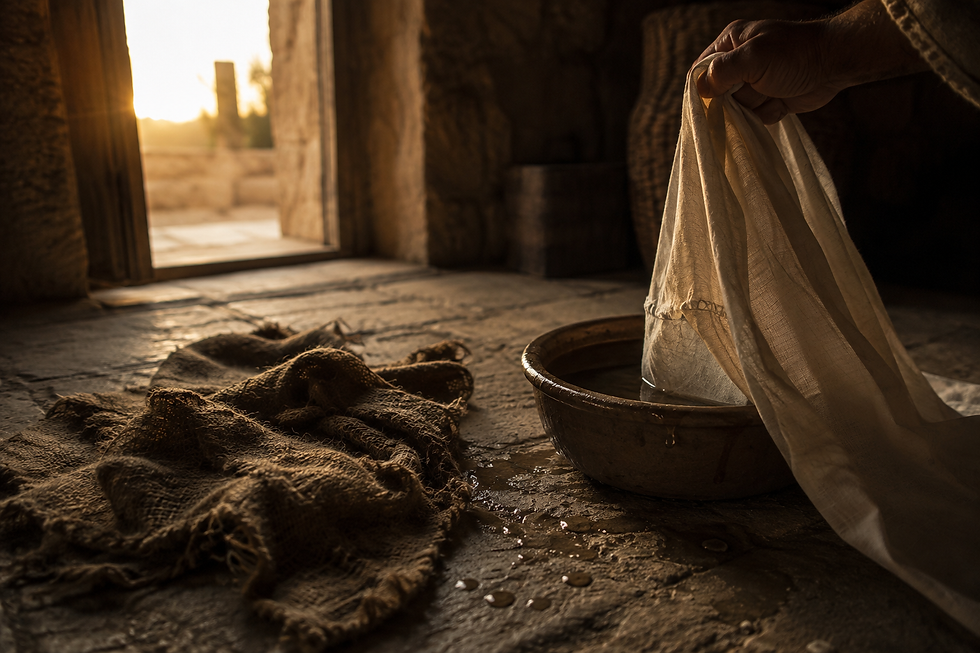
David enters 2 Samuel 12 carrying the consequences of devastating choices. After committing adultery with Bathsheba and arranging Uriah’s death, David is confronted by Nathan and finally confesses, “I have sinned against the LORD.” God forgives him, but forgiveness does not erase every consequence of what has happened. When David’s child becomes gravely ill, he fasts, weeps, and pleads with God. Yet when the child dies, David does something unexpected: he rises, washes, changes his clothes, enters the house of the LORD, and worships.
That response becomes the turning point of the chapter. David cannot undo his failure, manipulate God through prayer, or escape the painful consequences of his choices. But neither does he remain buried beneath shame. He receives what he cannot change, worships the God whose goodness has not changed, comforts Bathsheba, receives unexpected mercy in the birth of Solomon, and finally returns to the battlefield he abandoned in chapter 11. The invitation of the passage is not to minimize sin but to discover what repentance makes possible on the other side of it: receive grace, learn from the failure, change your posture, and return faithfully to the place God has called you to occupy.
Sermon Outline
I. Confronted by the Word
Main Teaching Point: Genuine restoration begins when we stop defending ourselves and receive the truth God reveals.
Key Scripture: 2 Samuel 12:1–14
Nathan confronts David with the parable of the rich man who steals a poor man’s only lamb. David condemns the injustice before Nathan declares, “You are the man.” David has previously treated God's word with contempt, but when confronted, he finally acknowledges the truth: “I have sinned against the LORD.”
Significantly, David does not make Nathan his enemy for telling him an uncomfortable truth. The sermon uses this to challenge us to receive faithful biblical correction rather than resent those who lovingly bring God’s Word into the places we would rather protect.
II. Forgiveness Does Not Always Remove Consequences
Main Teaching Point: God forgives David, but David must still walk through the consequences of his choices.
Key Scripture: 2 Samuel 12:13–15
Nathan immediately tells David:
“The LORD has taken away your sin. You are not going to die.”
Grace is already present.
Yet the following verses make equally clear that David's actions have consequences. Biblical forgiveness is therefore not permission to treat sin casually. God’s grace restores our relationship with Him, but repentance does not necessarily reverse everything our choices have set in motion.
This is part of holy living: grace does not teach us that sin does not matter; grace teaches us to take both God and sin seriously.
III. Prayer Is Surrender, Not Leverage
Main Teaching Point: Prayer and fasting bring us before God; they do not place God under our control.
Key Scripture: 2 Samuel 12:16–17
David desperately pleads for the child. He fasts, spends the night on the ground, and refuses food.
The sermon makes an important distinction: spiritual disciplines are not mechanisms for manipulating God. We cannot turn prayer, fasting, obedience, or sacrifice into leverage—I did this, therefore God must give me that.
David enters prayer hoping his circumstances will change. But the deeper transformation occurring during those seven days is happening within David himself.
Prayer is not primarily about bending God toward our will. It is one of the places where our desires are brought honestly into the presence of God and gradually surrendered to His.
IV. “Who Knows?” — Humility Before God
Main Teaching Point: Faith can ask boldly without pretending to know what God has not revealed.
Key Scripture: 2 Samuel 12:22
Later David explains his fasting:
“I thought, ‘Who knows? The LORD may be gracious to me and let the child live.’”
Those words reveal something remarkably different from the David of chapter 11.
Chapter 11 showed a king accustomed to getting what he wanted. He summoned Bathsheba. He summoned Uriah. He issued orders to Joab. David manipulated people and circumstances to produce his preferred outcome.
But now David says:
“Who knows?”
He asks God for what he desperately wants while acknowledging that the final decision belongs to God.
That is humility: I can ask. God remains God.
V. Worship When the Answer Is No
Main Teaching Point: God's worthiness does not depend upon our preferred outcome.
Key Scripture: 2 Samuel 12:18–20
When David learns that the child has died, he rises from the ground. He washes. He anoints himself. He changes his clothes.
Then:
“He went into the house of the LORD and worshiped.”
This is the theological center of the sermon.
David does not worship because the circumstances became good. He worships because God is still God.
The sermon presses this even further: if David can worship while experiencing the painful consequences of his own sin, believers can learn to worship God amid the many sufferings of life that are not divine judgment.
Worship is ultimately a declaration about God's worth, not our circumstances.
VI. Grief Gives Way to Hope
Main Teaching Point: Biblical grief acknowledges what has been lost without surrendering hope in God.
Key Scriptures: 2 Samuel 12:21–23; Psalm 23:6
David explains:
“I will go to him, but he will not return to me.”
The sermon connects this with David's confidence in Psalm 23:
“I will dwell in the house of the LORD forever.”
David recognizes that fasting cannot reverse death. He cannot bring his son back. There comes a point when faithful surrender means accepting what cannot be changed and entrusting what we have lost to God.
A helpful interpretive distinction
The sermon understands David's statement as expressing hope of reunion beyond death. That is a longstanding Christian reading and fits the broader biblical hope of resurrection and eternal life. The sentence in 2 Samuel 12:23 itself, however, does not explicitly explain the afterlife. At minimum, David acknowledges the irreversible boundary of death: the child will not return to him, but David will eventually follow him in death.
For Christian readers, that unresolved Old Testament grief ultimately finds its fullest answer in Jesus Christ and the resurrection (John 11:25–26; 1 Corinthians 15:20–22; 1 Thessalonians 4:13–18).
VII. Mercy Does Not Always Look Like the Answer We Requested
Main Teaching Point: God's grace may appear differently than we expected.
Key Scripture: 2 Samuel 12:24–25
David comforts Bathsheba, and she later gives birth to Solomon.
The text says simply and beautifully:
“The LORD loved him.”
God then sends Nathan with another name for the child:
Jedidiah — “beloved of the LORD.”
Earlier David had prayed:
“Who knows? The LORD may be gracious to me…”
God was gracious.
But grace did not take the form David requested.
The first child was not spared. Instead, God continued working within a deeply broken story. Solomon would eventually become David's successor and build the temple David longed to build.
Grace does not erase the past. Grace demonstrates that God can still write faithfulness into the future.
Word clarification: Solomon (שְׁלֹמֹה, Shelomoh) is related to the Hebrew word shalom and carries the sense of peace/peaceable. It is Jedidiah (יְדִידְיָהּ) that explicitly means “beloved of the LORD.”
VIII. Return to the Place You Abandoned
Main Teaching Point: Restoration eventually calls us back into faithful obedience.
Key Scriptures: 2 Samuel 11:1; 12:26–31
The closing battle account may initially seem disconnected from everything preceding it.
It isn't.
Chapter 11 begins:
“In the spring, at the time when kings go off to war…”
But David remained in Jerusalem.
That decision created the setting in which his catastrophic failure unfolded.
Then, near the end of chapter 12, Joab sends word from Rabbah:
“Now muster the rest of the troops and besiege the city and capture it…”
And this time:
“So David mustered the entire army and went to Rabbah…”
The contrast is striking.
2 Samuel 11: David stayed.
2 Samuel 12: David went.
The restored David responds differently at precisely the place where the failing David previously withdrew.
Repentance is therefore more than feeling sorry about where we went wrong. It eventually produces a changed response.
IX. Get Back in the Fight
Main Teaching Point: Shame says failure disqualifies you forever; grace calls the repentant believer back into faithful kingdom participation.
Key Scriptures: 2 Samuel 12:26–31; Ephesians 2:10
The sermon ends here: “Get back in the battlefield. Get back where you belong.”
That does not mean pretending nothing happened. David still lives with consequences. Restoration does not make chapter 11 disappear.
But failure is not permitted to become his permanent identity.
There is an important Christian distinction here:
Grace does not call us back to prove ourselves worthy. Jesus has already accomplished what we could never accomplish for ourselves. Grace restores us so that we can again walk faithfully in the good works God has prepared for us.
The Church of God describes Christian discipleship in similarly active terms: what believers confess must become visible in what they do; followers of Jesus are called to participate together in bringing God's kingdom to life.
The question on the other side of repentance therefore becomes:
Knowing what brought me here, what must obedience look like now?
Scripture References
Scripture | Significance |
2 Samuel 11:1–27 | Provides the background of David's adultery with Bathsheba, manipulation of Uriah, and Uriah's death. |
2 Samuel 11:27 | Establishes God's assessment: what David had done “displeased the LORD.” |
2 Samuel 12:1–7 | Nathan's parable exposes David's sin, culminating in “You are the man.” |
2 Samuel 12:9–12 | God identifies David's actions as contempt for His Word and announces consequences within David's household. |
2 Samuel 12:13–14 | David confesses his sin, receives forgiveness, and learns that serious consequences will remain. |
2 Samuel 12:15–16 | The child becomes ill and David begins pleading, fasting, and mourning before God. |
Exodus 11–12 | Referenced as a comparison with God's judgment against Pharaoh and Egypt involving the firstborn. |
2 Samuel 12:17–18 | David's servants watch his intense grief and fear his response when the child dies. |
Leviticus 12:1–4 | Referenced regarding the period of purification following childbirth. |
2 Samuel 12:19–20 | David learns of the child's death, ends his fast, and worships the LORD. |
Galatians 6:7–8 (strongly implied) | Provides the biblical principle behind the sermon’s discussion of sowing, reaping, and consequences. |
2 Samuel 9:7–13 | Mephibosheth's place at David's table is recalled as an earlier picture of mercy. |
2 Samuel 12:21–22 | David explains that while the child lived, he continued asking God for mercy. |
2 Samuel 12:23 | David acknowledges that the child will not return to him, though he will eventually “go to him.” |
Psalm 23:6 | Used to connect David's words with his confidence that he would dwell with the LORD forever. |
2 Samuel 12:24–25 | Bathsheba gives birth to Solomon; God loves the child and gives him the name Jedidiah through Nathan. |
2 Samuel 12:26–31 | Joab summons David to Rabbah, and David returns to battle and participates in capturing the city. |
2 Samuel 11:1 | Revisited to highlight the contrast: previously, David remained in Jerusalem when kings went to war. |
Ephesians 2:10 (thematically connected) | Supports the sermon’s call to restored believers to return to active, faithful kingdom obedience. |
Word Study
בָּזָה | Bāzâ | “Despise”
Hebrew: בָּזָה
Transliteration: bāzâ
Strong's: H959
Pronunciation: baw-ZAW
Literal Meaning
To despise, disdain, regard with contempt, consider insignificant, or hold in low esteem.
Expanded Definition
Bāzâ does not necessarily describe emotional hatred. It can describe treating something as though it carries little value, authority, or weight.
That distinction matters enormously in 2 Samuel 12.
David did not need to announce, “I hate God,” in order to despise Him. His choices communicated what his mouth may never have said. God's command had become less important to David than David's desire.
Synonyms
despise
disdain
disregard
devalue
treat lightly
hold in contempt
consider insignificant
Conceptual Antonyms
honor
esteem
treasure
obey
revere
fear the Lord
Major Biblical Occurrences
Genesis 25:34Esau “despised” his birthright. His actions revealed that he considered something enormously valuable to be worth less than immediate appetite.
1 Samuel 2:30God contrasts those who honor Him with those who despise Him.
1 Samuel 17:42Goliath “despised” David because David appeared insignificant in his eyes.
2 Samuel 12:9God asks David why he “despised the word of the LORD.”
2 Samuel 12:10God moves from David despising His Word to the deeper reality: “you despised me.”
Theological Significance
This word exposes the spiritual anatomy of David's sin.
The rooftop was not the true beginning.
Reflection Questions
Observation: What specific changes do you notice in David's actions and posture between 2 Samuel 11:1 and 2 Samuel 12:20–31?
Interpretation: What does David's decision to worship after the child's death reveal about his understanding of God's character, and how does his statement “Who knows? The LORD may be gracious to me” reveal a change in his understanding of himself?
Application: Where has guilt, shame, disappointment, or past failure tempted you to withdraw from faithful obedience—and what would “getting back in the fight” look like without minimizing what happened or trying to prove yourself to God?



.png)
Comments